
Quick Answer: Heart Failure vs Heart Attack
A heart attack and heart failure are two different heart conditions. A heart attack occurs when blood flow to part of the heart muscle is reduced or blocked, causing injury to the heart muscle. Heart failure occurs when the heart cannot pump or fill effectively enough to meet the body’s needs. A heart attack can damage the heart and may eventually contribute to heart failure, but having heart failure does not necessarily mean that a person is having a heart attack.
This distinction is important because the symptoms, urgency, diagnosis, and treatment can be very different.
Heart Attack and Heart Failure Are Not the Same
“Heart failure” sounds frightening because many people interpret it to mean that the heart has stopped working.
It doesn’t.
Similarly, a “heart attack” does not mean that the heart has stopped beating.
These are two different medical problems.
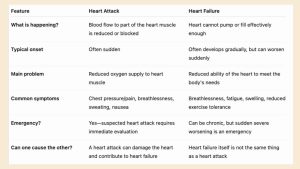
A heart attack is primarily a blood-flow problem: an artery supplying the heart becomes blocked or severely restricted, depriving part of the heart muscle of oxygen.
Heart failure is primarily a pumping or filling problem: the heart is unable to adequately meet the body’s need for blood and oxygen.
Understanding this difference can help patients recognize symptoms and seek the right care at the right time.
What Is a Heart Attack?
A heart attack, medically called a myocardial infarction, happens when blood flow to part of the heart muscle is reduced or blocked.
The heart muscle needs a continuous supply of oxygen-rich blood. If an artery becomes blocked and blood flow isn’t restored quickly, the affected heart muscle begins to become injured and can die.
A heart attack is therefore an acute medical emergency.
- Common causes include:
- Coronary artery disease
- Rupture of a cholesterol-containing plaque
- Formation of a blood clot
- Severe narrowing of a coronary artery
- Less commonly, conditions such as spontaneous coronary artery dissection
The sooner appropriate treatment is provided, the more heart muscle may be preserved.
What Is Heart Failure?
Heart failure means the heart is not able to pump enough blood to meet the body’s needs or cannot fill properly.
It does not mean that the heart has stopped.
Heart failure can develop gradually over months or years, although it can also worsen suddenly and require emergency treatment.
People with heart failure may experience:
- Breathlessness
- Fatigue
- Reduced ability to exercise
- Swelling of the legs or ankles
- Persistent cough or wheezing
- Difficulty breathing when lying down
- Sudden weight gain from fluid retention
- Reduced ability to perform everyday activities
The symptoms and severity can vary significantly from one person to another.
Heart Failure vs Heart Attack: The Key Difference
What Does a Heart Attack Feel Like?
A heart attack does not always feel exactly the same for everyone.
Common warning signs include:
Chest discomfort
It may feel like:
- Pressure
- Tightness
- Squeezing
- Heaviness
- Fullness
- Pain
Pain in other parts of the body
Discomfort can spread to:
- One or both arms
- Shoulders
- Back
- Neck
- Jaw
- Upper abdomen
Other symptoms
A person may also experience:
- Shortness of breath
- Cold sweating
- Nausea or vomiting
- Lightheadedness
- Unusual tiredness
- Rapid or irregular heartbeat
Some heart attacks begin gradually with relatively mild symptoms rather than dramatic pain.
If you suspect a heart attack, do not wait for the symptoms to become severe. Seek emergency medical attention immediately.
What Does Heart Failure Feel Like?
Heart failure often presents differently.
One of the most common symptoms is breathlessness.
Initially, a person may notice:
“I used to climb two floors comfortably. Now I have to stop after one.”
Over time, symptoms can become more noticeable.
You may experience:
- Breathlessness while walking
- Breathlessness while lying flat
- Waking up at night because of difficulty breathing
- Swollen feet or ankles
- Persistent tiredness
- Reduced exercise capacity
- Rapid weight gain due to fluid retention
These symptoms may develop gradually, which means people sometimes attribute them to aging, lack of fitness, or simply being tired.
But persistent or worsening symptoms deserve medical evaluation.
Can a Heart Attack Cause Heart Failure?
Yes.
This is where the two conditions can become connected.
A significant heart attack can damage part of the heart muscle. If enough muscle is damaged, the heart may become weaker and may no longer pump effectively.
Over time, this can contribute to heart failure.
This is one reason early treatment of a heart attack is so important. The faster blood flow is restored when appropriate, the greater the opportunity to limit heart-muscle damage.
However, not everyone who has a heart attack develops heart failure.
Can You Have Heart Failure Without Ever Having a Heart Attack?
Yes.
A heart attack is only one possible cause of heart failure.
Other causes include:
- Long-standing high blood pressure
- Heart valve disease
- Cardiomyopathy
- Certain heart-rhythm disorders
- Congenital heart disease
- Diabetes and associated cardiovascular disease
- Some infections
- Certain toxins or medications
- Genetic conditions
This is why heart failure can occur in people who have never experienced a heart attack.
The underlying cause needs to be identified because treatment depends partly on what has damaged or weakened the heart.
Does a Low Ejection Fraction Mean You Have Had a Heart Attack?
No.
Ejection fraction, or EF, is a measurement of how much blood the left ventricle pumps out with each heartbeat.
A reduced EF can occur after a heart attack, but it can also occur because of many other conditions, including cardiomyopathy and other forms of heart failure.
Importantly, heart failure can also occur when the ejection fraction is not reduced. Some patients have a relatively preserved EF but have a heart that is too stiff to fill normally.
Therefore, EF is an important measurement—but it is only one part of the overall cardiac assessment.
How Are Heart Attack and Heart Failure Diagnosed?
Doctors don’t diagnose these conditions based on symptoms alone.
Depending on the situation, evaluation may include:
For suspected heart attack
- ECG/EKG
- Cardiac blood tests such as troponin
- Echocardiography
- Coronary angiography
- Other cardiac imaging when appropriate
The combination of clinical symptoms, ECG findings, blood tests, and imaging helps determine whether a heart attack has occurred and how much damage may have resulted.
For suspected heart failure
Doctors may use:
- Medical history
- Physical examination
- Blood tests
- ECG
- Echocardiogram
- Chest X-ray
- Exercise testing
- Cardiac imaging
- Cardiac catheterization when appropriate
No single test tells the entire story. Doctors combine the results to understand the heart’s structure, function, and the underlying cause of symptoms.
Is Heart Failure Always the Result of a Heart Attack?
No.
This is one of the most common misconceptions.
A person can develop heart failure without ever experiencing a heart attack.
Similarly, having a heart attack does not automatically mean that someone will develop heart failure.
The relationship is more accurately described as:
Heart attack → possible heart-muscle damage → possible weakening of heart function → possible heart failure
But this sequence does not occur in every patient.
Can Heart Failure Be Treated?
Yes.
Heart failure is a serious condition, but it does not mean that treatment has stopped.
Depending on the type and cause of heart failure, treatment may include:
- Evidence-based medications
- Lifestyle modifications
- Management of blood pressure and diabetes
- Treatment of coronary artery disease
- Valve procedures or surgery where appropriate
- Pacemakers or other cardiac devices in selected patients
- Cardiac rehabilitation
- Advanced therapies for severe heart failure
Some patients experience significant improvement in heart function and symptoms with appropriate treatment. The American Heart Association notes that heart failure can be managed, and some patients may experience remission with treatment and healthy lifestyle changes.
When Does Heart Failure Become Serious?
Heart failure can progress through different stages.
Advanced or Stage D heart failure refers to disease in which symptoms significantly interfere with daily life or lead to hospitalization despite treatment.
At this stage, doctors may need to consider advanced treatment options, depending on the individual patient.
These can include:
- Advanced medication strategies
- Cardiac devices
- Mechanical circulatory support
- Heart transplantation in appropriately selected patients
This is also why our earlier article, “When Is a Heart Transplant the Only Option?”, fits naturally within this topic cluster.
When Should You Seek Emergency Help?
Don’t try to determine at home whether a symptom is “heart failure” or “heart attack.”
Seek emergency medical care if you develop new or severe chest pressure or pain, especially if it is accompanied by breathlessness, sweating, nausea, dizziness, or discomfort spreading to the arm, jaw, neck, back, or upper abdomen.
Similarly, sudden severe breathlessness, fainting, or rapidly worsening symptoms in someone with known heart failure can require urgent medical assessment.
When it comes to potentially serious cardiac symptoms, it is safer to be evaluated promptly than to wait and see what happens.
A Cardiologist’s Perspective
In clinical practice, I often find that patients use the terms heart attack and heart failure as though they describe the same condition.
They don’t.
A heart attack is an event in which part of the heart muscle is deprived of blood supply. Heart failure describes a state in which the heart is unable to adequately meet the body’s circulatory demands.
But there is an important connection between them.
A heart attack can damage the heart and become one of the causes of heart failure. This is why preventing coronary artery disease, recognizing heart-attack symptoms early, and treating a heart attack promptly are all important parts of protecting long-term heart function.
At the same time, patients already living with heart failure should understand that heart failure is not the same as the heart stopping. With appropriate treatment and monitoring, many patients can continue to lead meaningful and active lives.
Frequently Asked Questions
Is heart failure worse than a heart attack?
They are different conditions, so one cannot simply be described as “worse.” A heart attack is an acute emergency that can cause permanent heart-muscle damage, while heart failure is usually a chronic condition that can range from mild to advanced.
Can a heart attack turn into heart failure?
Yes. A heart attack can damage enough heart muscle to weaken the heart’s pumping ability and contribute to heart failure.
Can heart failure cause a heart attack?
Heart failure and heart attack have different mechanisms. Heart failure itself is not the same as a heart attack, although people with cardiovascular disease can have both conditions.
What is the biggest difference between heart attack and heart failure?
A heart attack is primarily a blood-flow problem affecting heart muscle. Heart failure is a problem with the heart’s ability to pump or fill adequately.
Is breathlessness a symptom of a heart attack or heart failure?
It can occur with both. During a heart attack, breathlessness may occur with or without chest discomfort. In heart failure, breathlessness is a common symptom and may develop during activity, when lying down, or as the condition worsens.
Can someone have heart failure with a normal ejection fraction?
Yes. Some patients have heart failure despite a preserved or relatively normal EF because the heart may have difficulty relaxing and filling properly.
Key Takeaways
- Heart attack and heart failure are not the same condition.
- A heart attack occurs when blood flow to part of the heart muscle is reduced or blocked.
- Heart failure means the heart cannot pump or fill adequately enough to meet the body’s needs.
- A heart attack can damage the heart and lead to heart failure.
- Heart failure can develop without a previous heart attack.
- Ejection fraction is important, but it does not tell the whole story.
- New chest pain, pressure, or associated symptoms should be treated as potentially serious and evaluated urgently.
- With appropriate treatment, many people living with heart failure can continue to lead active and meaningful lives.
Conclusion
The words heart attack and heart failure may sound similar, but they describe very different problems.
A heart attack is an acute event caused by inadequate blood flow to heart muscle. Heart failure is a condition in which the heart cannot adequately pump or fill to meet the body’s needs.
Understanding the difference matters—not just for medical knowledge, but because recognizing the right symptoms at the right time can influence how quickly someone receives care.
If you have risk factors for cardiovascular disease, persistent breathlessness, reduced exercise tolerance, swelling, recurrent chest discomfort, or other unexplained cardiac symptoms, don’t ignore them. A timely cardiac evaluation can help identify the underlying problem and determine the appropriate treatment.