Walk into any cardiac clinic today and you will often hear a patient say: “Doctor, just do laser angioplasty and remove the blockage permanently.” The word laser gives a powerful impression — precision, completeness, and cure. Many people imagine it works like a cosmetic laser that erases a problem forever. But heart disease does not behave like a skin lesion, and laser angioplasty was never designed to be a permanent cure.
It is an advanced and valuable procedure, but it treats a blockage, not the disease that caused it.
What Exactly Is Laser Angioplasty?
Laser angioplasty, medically known as Excimer Laser Coronary Atherectomy (ELCA), is a specialized form of coronary angioplasty used in selected cases.
The steps are similar to standard angioplasty:
- A catheter enters through the wrist or groin
- A laser-tipped catheter reaches the narrowed artery
- Ultraviolet pulses break plaque or clot into tiny particles
- Balloon angioplasty is performed
- A stent is usually placed
So the laser does not replace angioplasty — it assists it when the blockage is difficult.
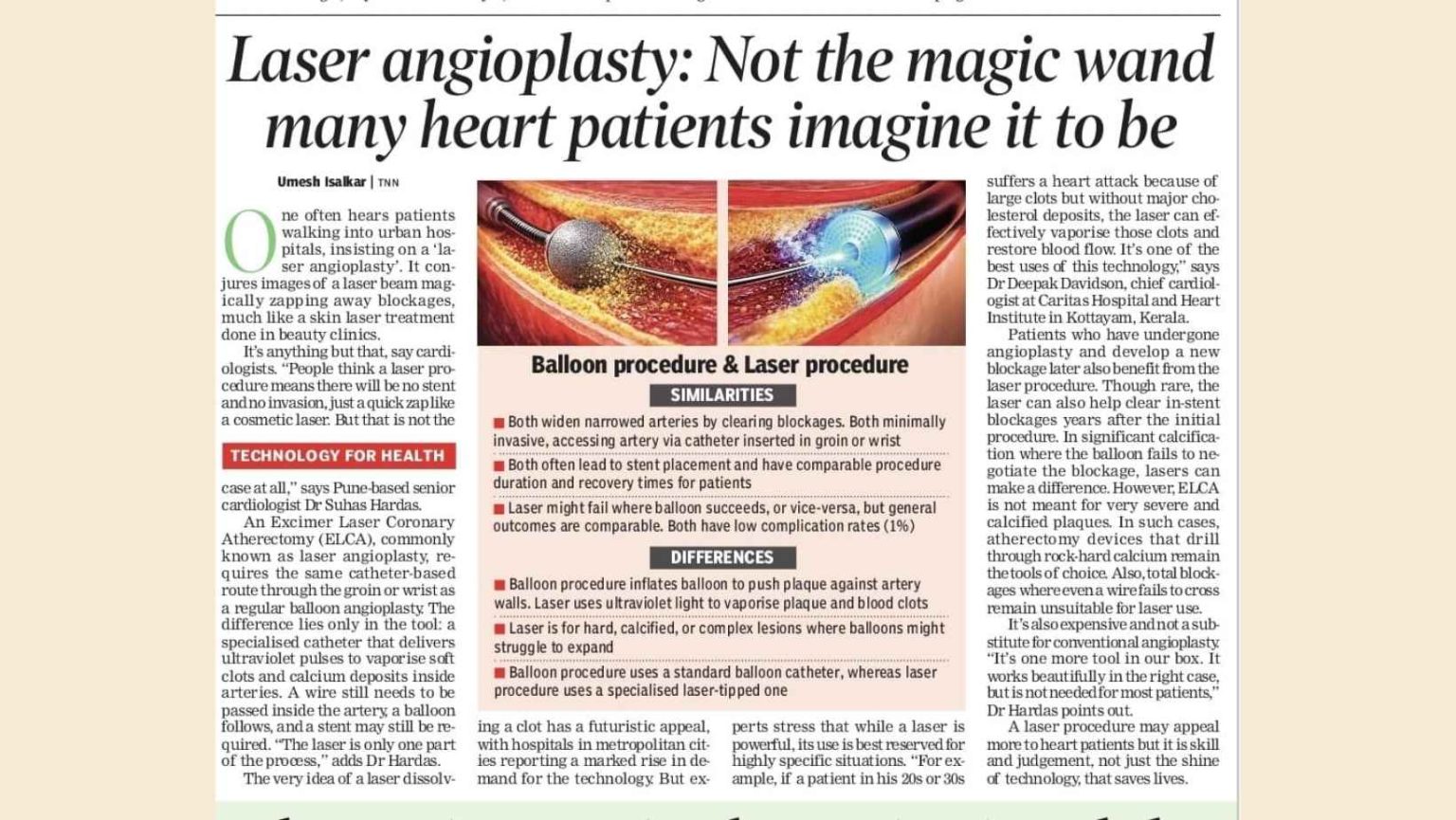
Balloon vs Laser: What’s the Difference?
Both procedures widen narrowed arteries and restore blood flow. Both are minimally invasive and require similar recovery time.
The difference lies in how the blockage is handled:
Balloon angioplasty pushes plaque against the artery wall
Laser angioplasty vaporizes plaque or clot to help the balloon expand
Laser is mainly helpful when the blockage is hard, calcified, or resistant to standard treatment.
When Doctors Actually Use Laser Angioplasty
Laser angioplasty is not used routinely. It is reserved for specific situations such as:
1. Clot-rich heart attacks
Large clots without heavy cholesterol plaque can be vaporized to restore flow.
2. In-stent blockage
If tissue grows inside an old stent, laser helps reopen it.
3. Moderately calcified plaque
When the balloon cannot expand the artery properly.
4. Complex lesions
Where conventional angioplasty tools fail.
An experienced cardiologist like Dr. Suhas Hardas evaluates whether the patient truly benefits from laser assistance or whether standard angioplasty is enough.
What Laser Angioplasty Does NOT Do
This is the most important part patients misunderstand.
Laser angioplasty:
- Opens a blocked artery
- Improves blood flow
- Relieves chest pain
- Helps in emergency treatment
But it does NOT:
- Cure cholesterol disease
- Prevent new blockages
- Eliminate heart attack risk
- Remove need for medicines
It fixes the effect — not the cause.
The Real Cause: Atherosclerosis
Heart blockage develops due to a chronic condition called atherosclerosis.
This is not a single deposit inside one artery. It is a lifelong disease affecting the entire circulatory system.
It develops because of:
- High cholesterol
- Diabetes
- Smoking
- High blood pressure
- Obesity
- Stress
- Genetics
Even after a perfectly successful laser angioplasty, this disease continues unless risk factors are controlled.
Why Blockages Return After Angioplasty
Patients often feel disappointed when another blockage appears years later. But medically this is expected.
Reasons include:
Disease progression – Other arteries continue accumulating plaque
Restenosis – Healing causes narrowing again at the treated site
Unchanged lifestyle – Smoking and diet continue damaging arteries
Metabolic disorders – Diabetes accelerates plaque formation
Laser cannot stop these processes.
Medicines After Procedure: Absolutely Essential
Many patients think once the artery is opened, medicines are optional. This is dangerous.
After angioplasty, lifelong treatment is required:
Antiplatelet medicines
Prevent clot formation in the stent
Statins
Stabilize plaque throughout the body
Blood pressure medicines
Protect the artery lining
Diabetes control
Reduces future heart attack risk
Stopping medicines is one of the most common reasons for sudden cardiac emergencies after a successful procedure. Any responsible top cariologist in pune will emphasize medication adherence more than the procedure itself.
The Biggest Misconception
Patients feel:
“Blockage removed means heart disease cured.”
In reality:
- The artery becomes functional, not normal
- Other arteries may still be diseased
- Future heart attacks remain possible
- Laser angioplasty is best understood as a repair, not a cure.
What Actually Prevents Future Heart Attacks
Long-term survival depends far more on lifestyle than on the type of angioplasty performed.
Essential changes include:
- Strict cholesterol control
- Diabetes management
- Complete smoking cessation
- Regular exercise
- Weight reduction
- Stress control
Patients who follow these measures often live decades without major events. Those who depend only on procedures frequently return with repeat blockages.
Why the Word “Laser” Misleads Patients
The term sounds futuristic and definitive. It suggests a high-tech solution that permanently removes disease. In reality, it is simply another tool used in selected situations.
It works beautifully in the right patient — but offers no extra benefit when used unnecessarily.
How Patients Should Think About the Procedure
A simple analogy helps:
Laser angioplasty is like clearing traffic after an accident.
Traffic moves again, but unless driving habits improve, accidents will recur.
Heart disease works the same way.
Final Takeaway
Laser angioplasty is an important advancement in cardiology. It allows doctors to treat difficult blockages and restore blood flow in situations where conventional angioplasty struggles.
However, it is not a magic wand and never meant to be a permanent cure. The real treatment begins after the procedure — through medicines, lifestyle correction and regular follow-up.
Patients who understand this enjoy long and healthy lives.
Patients who rely only on procedures often face repeat emergencies.
Opening an artery saves a moment.
Controlling the disease saves a lifetime.